Pedestrian bridges are fantastic community assets. Yet delivering these important and often complex access structures on brief, on schedule and on budget can be fraught with many project risks and unknowns that need to expertly managed with early-stage problem solving and robust cost management.
Why engagement with FORGE today avoids blowouts tomorrow
Almost all pedestrian and active transport bridges are site-specific structures designed and engineered to suit the exact typography and environments in which they will sit.
This means your project budget isn’t linear, but rather a system of cascading impacts. And these impacts start as soon as your project does.
When it comes to ensuring budget certainty every upfront decision matters. Once the manufacturing and installation phases begin even small changes to your design, materials or methodology can trigger dramatic scope creep, hidden costs, variations and delays.
Time and again we see LGAs and developers opt for the lowest priced solution at tender, only to end up spending far more by handover due to fundamental buildability issues that should—and could—have been resolved months earlier.
Big or small, complex or simple, it’s critical to consider the whole-of-life value of your access structure. Is the cheapest upfront option really the most cost-effective solution? Or is it actually a just a sales trap destined to force you into un-budgeted financial contingencies—and awkward questions from your project stakeholders?
What are the most common budget pain points?
-
Ambiguous contract wording that exposes you to hidden exclusions once the project has been awarded
-
Misalignment of expectations or responsibilities between different project consultants, typically due to a lack of up-front collaboration and communication
-
Inaccurate or impractical span lengths specified for the site requiring urgent re-design
-
Over-designed ‘carbon intensive’ structures that incur unnecessary delivery, material and installation costs
-
Challenging ground conditions forcing unplanned changes to site preparation and installation methodology
-
Access restrictions making it difficult and/or costly to transport the required materials, tools and heavy equipment to the site
-
Underestimating regulatory and approval requirements from third parties such as water authorities and Aboriginal heritage bodies.


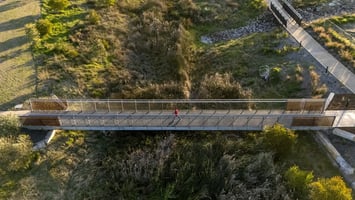
Above: 73-metre single-span cable-stayed pedestrian bridge in Horsham spanning the Wimmera River, delivering a direct connection between Hamilton Street and the eastern suburbs.
Protecting your budget through early collaboration with FORGE
At FORGE we know early involvement delivers significantly better budget outcomes by increasing clarity and removing risk before key decisions are locked in. It’s why we have the FORGE Methodology, a proprietary delivery model that continues to be proven through the successful delivery of high-profile community bridges across Australia.
The FORGE Methodology is a game-changer for budget certainty. It directly addresses the complexities of access projects by integrating all of the required design, engineering and construction expertise right from the very start.
It means more practical and buildable solutions and fewer (if any) budget surprises after construction contracts are signed.
By collaborating early to anticipate risks, streamline workflows and maximise value, you can always be confident your structures are designed in a way that allows them to be delivered more efficiently, on budget and to the highest standard—turning potential obstacles into predictable outcomes. Every time.
The FORGE Methodology can deliver greater budget certainty to your next access project.
Get in touch to find out more.