New bridge provides an important community link within the Hills Shire Council, removing geographic...
- Client
- Transport for NSW
- Project Partners
- CPB Contractors, Ghella ANZ, UGL (Joint Venture), Hassell (Design)
- State
- New South Wales

Delivering state-significant active transport infrastructure
FORGE was engaged under the CPB Ghella UGL Joint Venture to deliver eight critical community access structures as part of the wider M6 Motorway Stage 1 project for Transport for NSW—designated as state-significant infrastructure by the NSW Government.
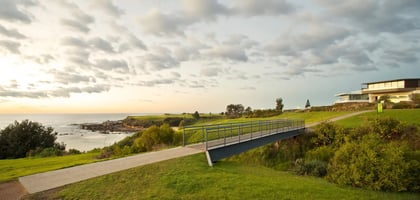
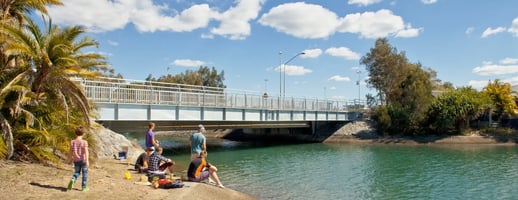
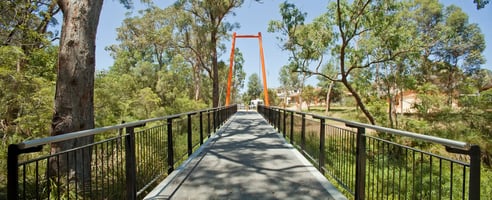
In addition to a network of multi-lane road links and tunnels, the M6 project called for six shared boardwalks and one new bridge to be installed along an adjacent Active Transport Corridor to reconnect local communities that had historically been separated by poor pedestrian and cycling access links.
The ambition was to deliver a structurally functional and aesthetically consistent family of bridges and boardwalks that integrated harmoniously within the wider architectural language of the M6 project.


Our involvement.
FORGE was appointed following a complex and highly competitive tender process. Engaged under the CPB Ghella UGL Joint Venture, our initial role in the M6 project involved detailed collaboration with a wide team of delivery partners and project stakeholders with comprehensive design, engineering and site analyses undertaken to ensure the safest and most efficient outcomes would be achieved for each of the seven structures.
Extensive shop detailing, methodology testing and environmental planning was undertaken during the pre-construction stage before groundworks and manufacturing began, followed by the careful pre-assembly of key structural sections of the bridges and boardwalks off-site. FORGE was responsible for overseeing all stages of the boardwalk and balustrade installation.


Design Challenge
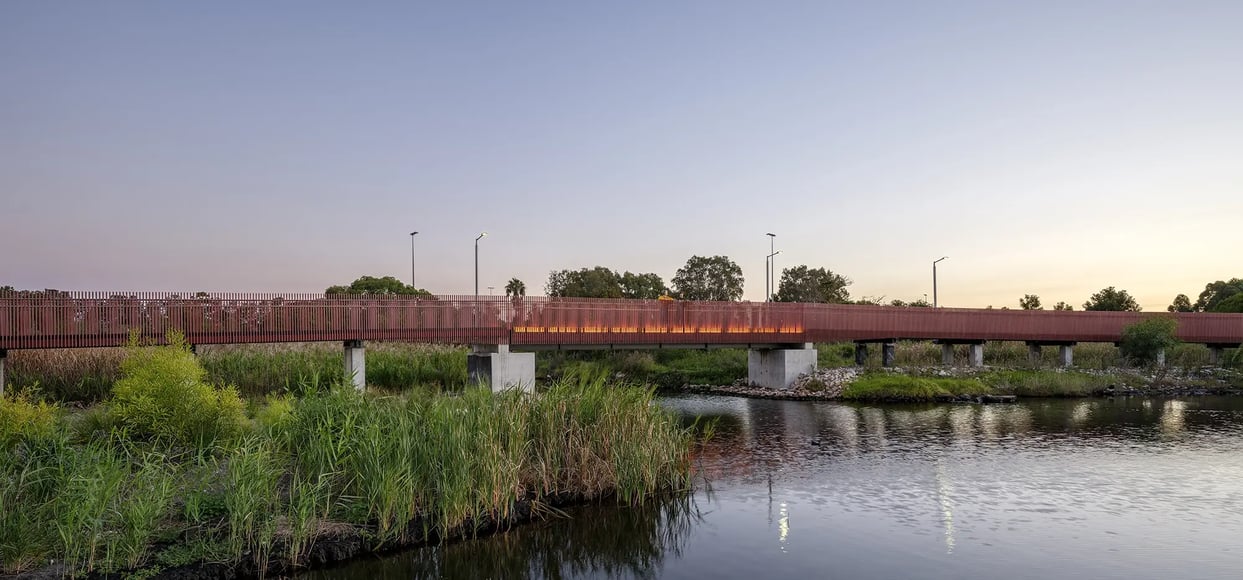
While the structural designs had been primarily determined by the respective project architects, FORGE was called upon to recommend subtle design improvements to optimise the manufacturing and installation stages. At a broader level, while each structure served different locations and typography, it was essential for the bridge and boardwalks to share a consistent family of forms, detailing, materials and finishes. The overall design intent was for the structures to be architectural elements that were attractive, welcoming and acted as signature items within the parkland experience.
There was also a considered attempt to avoid unnecessary embellishments to ensure a timeless design, with a focus on simple and elegant elements with slender profiles and accentuated forms that fit within their natural context. Smooth, clean lines were prioritised with minimum structural depths consistent with their spans, allowing for refined transitions to the shallower girders of the approach spans. One of the standout design features was the use of steel vertical battens painted with a striking copper metallic finish.
Construction Challenge
With seven major access structures being delivered in different locations along the M6 corridor, simultaneously, meticulous project management was essential to deliver efficiencies while remaining on delivery schedule. Given the proximity of many structures to local waterways and birdlife habitats such as Muddy Creek, environmental safety controls were also rigorous and directly shaped the final delivery methodology.
Features
- One pedestrian bridge (15.4-metre span)
- Six pedestrian boardwalks ranging from 17 to 104 metres (364 metres in total)
- One boardwalk features an integrated shelter and furniture
- Vertical balustrade panels
- Integrated accent and feature lighting
Materials
- Stainless steel handrails
- Steel girders and light posts
- Copper anodised perforated panels
- FRP micromesh heel guard decking
Safety & Risk Considerations
Multiple access and lifting options were explored for each structure in order to meet budget allowances while satisfying the unique safety and environmental requirements of each site. For example, one of boardwalks required crews to work over shallow water, while for another the safest methodology was to build out from the furthest point and work backwards.