How FORGE is embracing VR to deliver better design outcomes for clients on custom outdoor projects.
Not so long ago the concept of 'virtual reality' was considered as little more than a professional gimmick. But increasingly, this fast-evolving technology is transforming the way community structures are designed around the world, with Australia very much part of that shift, and the benefits can be significant.
Whether it's a custom playground, a sweeping pedestrian bridge and boardwalk network, or an intricate shade structure, one of the trickier challenges in the design process has always been helping clients actually see what they're approving.
Drawings and renders have done that job for generations. But virtual reality (VR) is rapidly changing how this important process can be managed. It's resulting in better collaboration, fewer variations and stronger client relationships.
%202.webp?width=922&height=638&name=VR%20in%20Design%20(Rico)%202.webp)
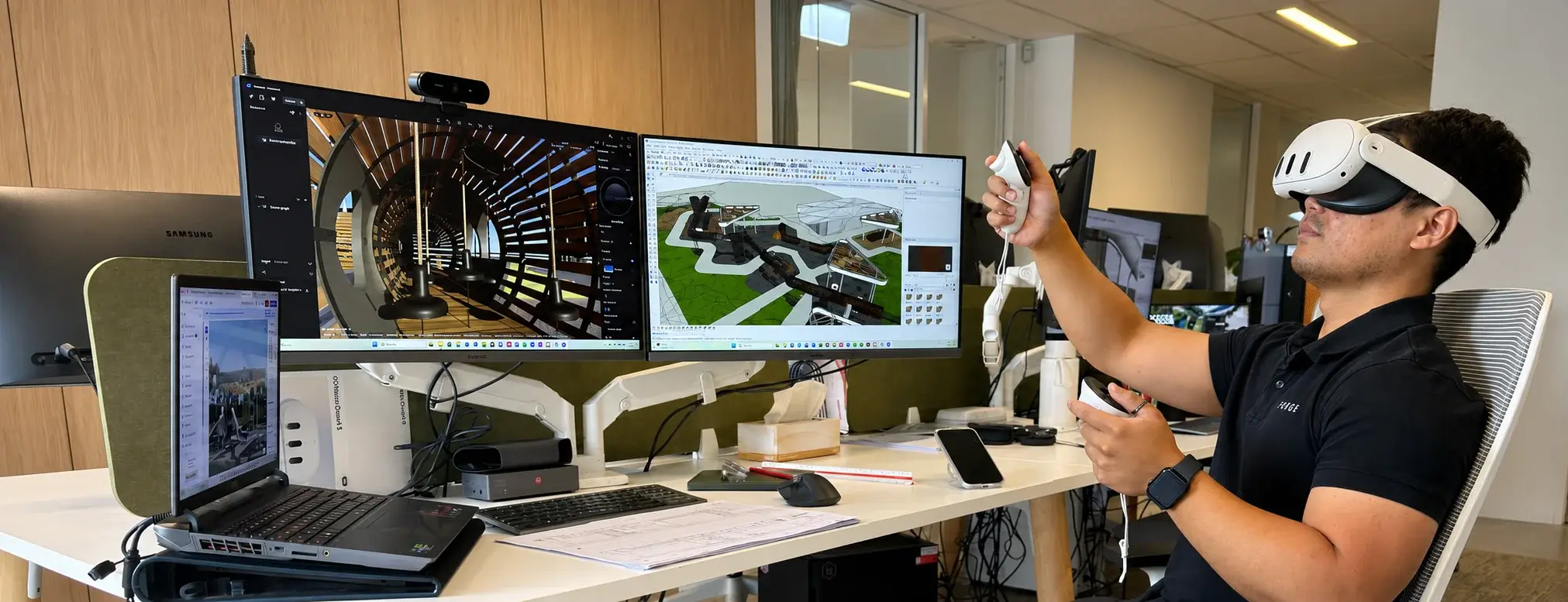
Above: Rico (Senior Architectural Technician at FORGE) reviewing Gunyama Park Stage 2 in virtual reality, allowing the team to experience the design at full scale, assess usability and identify potential issues long before construction begins.
VR helps clients experience a structure, not just imagine it
Every year misaligned expectations undermine the outcomes of community structure projects across Australia. A client signs off on a design, work begins, the structure goes up, but it becomes clear the sight lines are wrong, the scale doesn't sit comfortably within the wider site, or perhaps the colour palette reads completely differently once in context.
The engineering and workmanship itself is sound. But the design renders haven't quite translated into the real world as hoped. This is because traditional 2D drawings and even 3D renders often require a project team to make assumptions as they imagine how a final structure will be experienced in the real world, as well as the impact of external factors such as sunlight, shade and its relationship with surrounding habitats and structures.
At FORGE, our clients can step into a 1 : 1 scale model of their proposed playground before a single component is manufactured. They can walk across a virtual footbridge, look back at the surrounding landscape and immediately sense whether it feels right or if adjustments need to be made.
How does FORGE use VR on client projects?
Here at FORGE, we're building VR into our design workflow on selected projects using a proven in-house process and market-leading software.
The results are full-scale environments that our team members and clients can walk through, looking around and exploring whatever catches their eye in the design using the VR headset. Rather than simply watching a pre-determined fly through on a screen, they can physically stand inside a structure at human scale and feel immersed in the space.
This matters because when you're actually looking up at the underside of a shade shelter roof, walking along a mangrove boardwalk or turning around inside a custom play tower, your spatial instincts engage in a way they simply don't from a rendered image. Issues that might go unnoticed in a traditional sketch or render become immediately obvious.
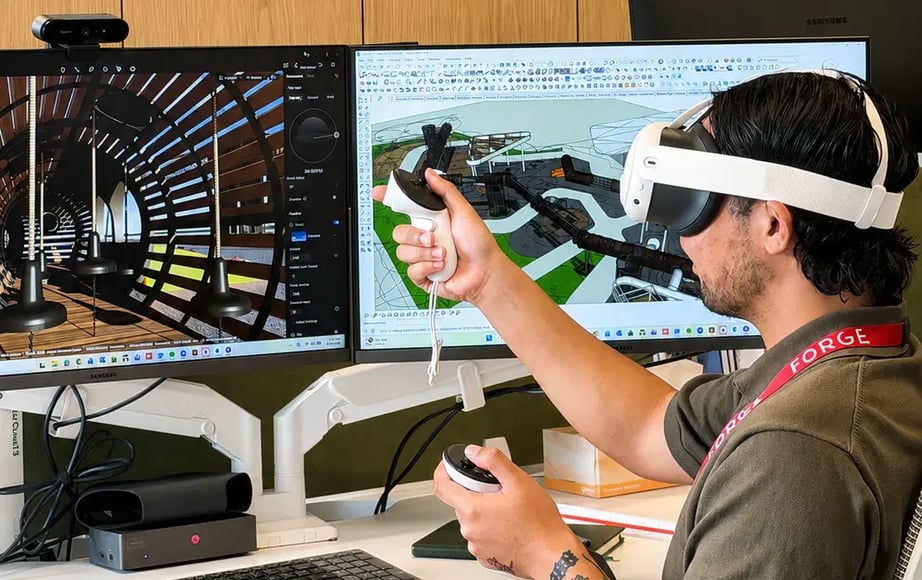
Above: Auston (Graduate Designer at FORGE) conducting a second review on Gunyama Park Stage 2 in virtual reality.
Where VR fits in the design process.
FORGE's design team use VR to review a wide range of design considerations from overall scale and play flow, to accessibility for both children and accompanying adults, to specific safety concerns like entrapments, tight clearances, climbable elements and internal fall risks. We use it to answer all manner of design, safety and usability questions. Will I fit? Can I reach it? Will adults be able to get here if kids need assistance? VR allows all of these to be answered with far greater confidence than using static renders and drawings.
We use VR primarily during concept design and design development with additional applications in internal model reviews and client presentations. We're also finding it a valuable tool for coordinating with landscape architects, engineers and play certifiers before final designs are locked in, getting everyone aligned early rather than resolving conflicts late.
Proven results, measurable savings.
Clearly the real test of any design tool is whether it enhances the project process and outcome. Here at FORGE, VR has already done exactly that by delivering real-world improvements and savings on several major community projects:
- Custom Play Structure, Sydney — a VR review showed rubber platforms within the main play structure were positioned too close together for adults to move through comfortably, a potential circulation and safety issue that was easily resolved once seen at full scale.
- Entry Feature, South-East Queensland — the rear of the proposed structure was found to be climbable in a way that wasn't apparent from the drawings. The design was able to be easily refined with sloped read elements to address this potential safety issue, long before anything was fabricated.
- Custom Play Structure, Western Sydney — a particularly complex build with multiple internal spaces, moving through the model in VR identified several unexpected fall risks that led to meaningful design changes, including the introduction of rope and rubber components to reduced hazard exposure.
On each of these projects, the issue wasn't an engineering oversight. It was a spatial reality that only became visible when experienced at human scale through the VR process.
.webp?width=922&height=691&name=VR%20in%20Design%207%20(Gunyama).webp)
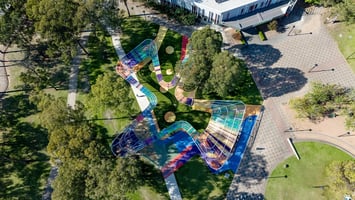
Above: The final result at Gunyama Stage 2 Playground.
The future is here - be part of it with FORGE.
For now VR is used selectively on FORGE projects where the design complexity, site risks or high stakeholder expectations warrant its use as a powerful additional review step.
We have no doubt its role will continue to grow at FORGE as more Australian councils, developers and landscape architects place value on seeing and experiencing their structure at human scale.
—
If you’d like to explore how VR could enhance the design process on an upcoming project that you're about to embark on, or would like to see a demonstration by our team, please get in touch.